
Case Brief
"Qidian" is a registered trademark No. 9563248 under Company A, filed for registration in 2011 and approved for use in Class 45 services such as "intellectual property consulting, copyright management, intellectual property licensing, intellectual property supervision, litigation services, and domain name registration." Transferred to Company A in February 2022, it has been a core brand for over a decade of the company and its affiliates in the trademark agency industry. On March 5, 2025, the China National Intellectual Property Administration upheld the trademark registration in a "uselessness cancellation" proceeding. However, a third party filed for review, and on March 30, 2026, the administration issued Review Decision No. 58405, stating that the submitted evidence "contained inconsistencies between invoices and verification results, lacked clear reference to the disputed trademark, failed to indicate formation dates or were self-made with weak probative force," failing to prove genuine use of the "Qidian" trademark during the specified period (August 6, 2021 to August 5, 2024) on the approved services, leading to its revocation. A brand built over years suddenly faced cancellation.
Legal intervention

Deeply engaged in the field of intellectual property for nearly 20 years, proficient in trademark, patent, copyright and other intellectual property administrative and infringement dispute full process agency, with rich experience in winning cases; At the same time, proficient in handling various civil and commercial cases, relying on professional legal literacy and accurate case analysis ability, we provide efficient and high-quality legal solutions for clients, and fully safeguard the legitimate rights and interests of the parties involved.
Case handling process
After taking over the case, Lawyer You Hongen immediately reviewed all the evidence in the administrative procedure one by one and quickly identified the "lifeline" of the case: the 8 invoices submitted during the administrative stage were marked with the words "starting point trademark" in the remarks column, which was inconsistent with the online inspection results. The court clearly stated that it will not accept the 8 invoices and will conduct a strict review of the evidence submitted by the plaintiff. This means that if the original evidentiary approach is used, the case has almost no chance of winning.
In the face of unfavorable circumstances, the lawyer established a supplementary evidence strategy based on "real transactions as the core and mutual verification as the principle", and reconstructed the evidence system in three steps: the first step is to trace back the business records. Guide the parties involved to systematically retrieve all business files within the specified period, including renewal notices, payment vouchers, and invoices with the Jinan company, to prove that the company continues to use the trademark query system to conduct agency business. The second step is to build a closed trading loop. Collect trademark registration commission contracts and agency contracts signed by Qidian Company and Jinguo Company with more than ten different entities, including Shanghai Automation, Ke Automation, Ming Technology, Shanghai Cosmetics, Changshu Weaving, Suzhou Industry, Suzhou Dieter, Huzhou E-commerce, Changshu Industry, Suzhou Intelligence, etc., during the designated period, and provide invoices, payment vouchers, and WeChat communication records one by one to form a complete closed loop of "contract payment performance". Step three, fix electronic evidence. In response to the characteristics of electronic evidence such as WeChat chat records being prone to loss and difficult to verify, screen recording and electronic data notarization will be carried out for business customer service WeChat records, employee customer contact records, and supplementary submission of some agency business invoices for 2021-2024, trademark administrative rulings of Qidian Company as an agent, trademark transfer contracts and payment vouchers, friend circle promotion screen recording, office photos, postal express invoices, etc., comprehensively restoring the real scene of continuous operation during the specified period.
In the trial, the lawyer linked the recognized contract invoices in the administrative stage with the supplementary evidence in the litigation stage to form a complete evidence chain, and argued layer by layer around the focus of the dispute: the evidence in the case is sufficient to prove that Qidian Company and Company A have continuously provided trademark application registration services to different parties during the designated period and have actually fulfilled them; If the "trademark application registration" and the "intellectual property consulting" services approved for use have the same or significant relevance in terms of service purpose, target audience, and method, it should be recognized that the disputed trademark has been used in the approved services; The rest of the review services are similar to "intellectual property consulting" services, so the registration of the disputed trademark should be maintained in all review services.
Case outcome
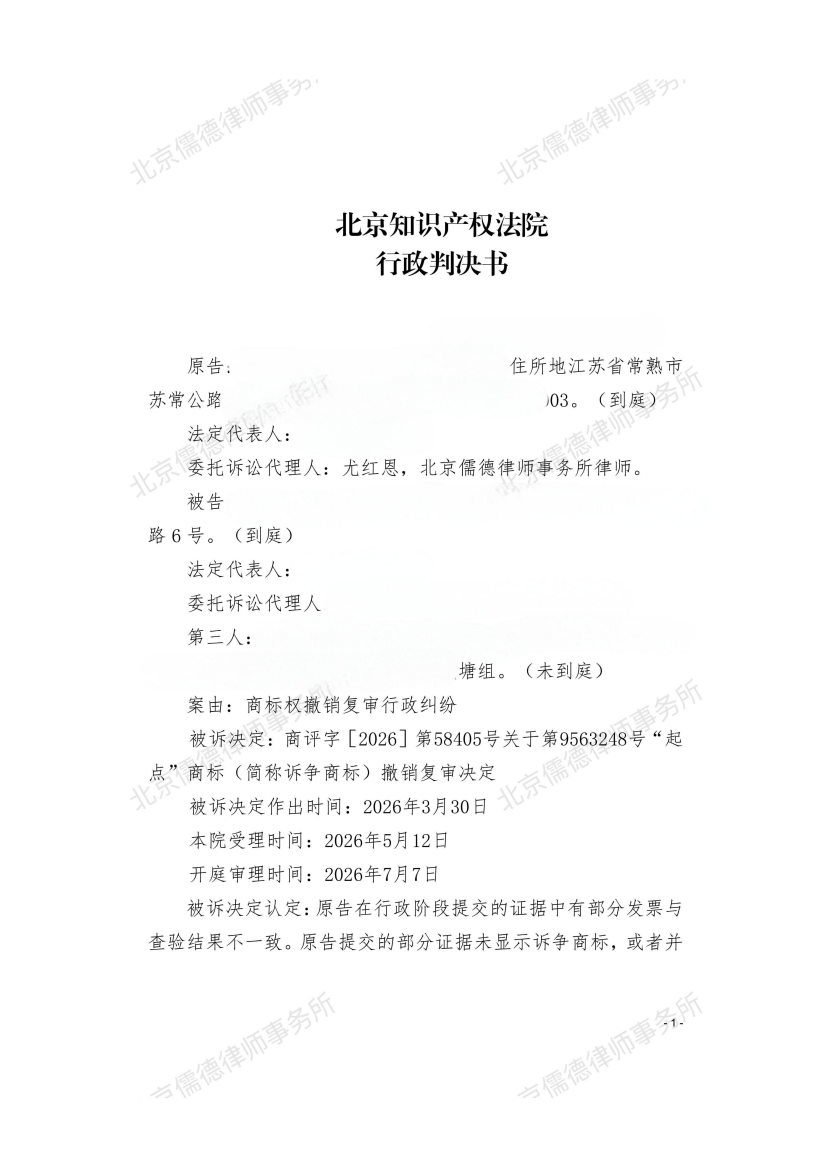
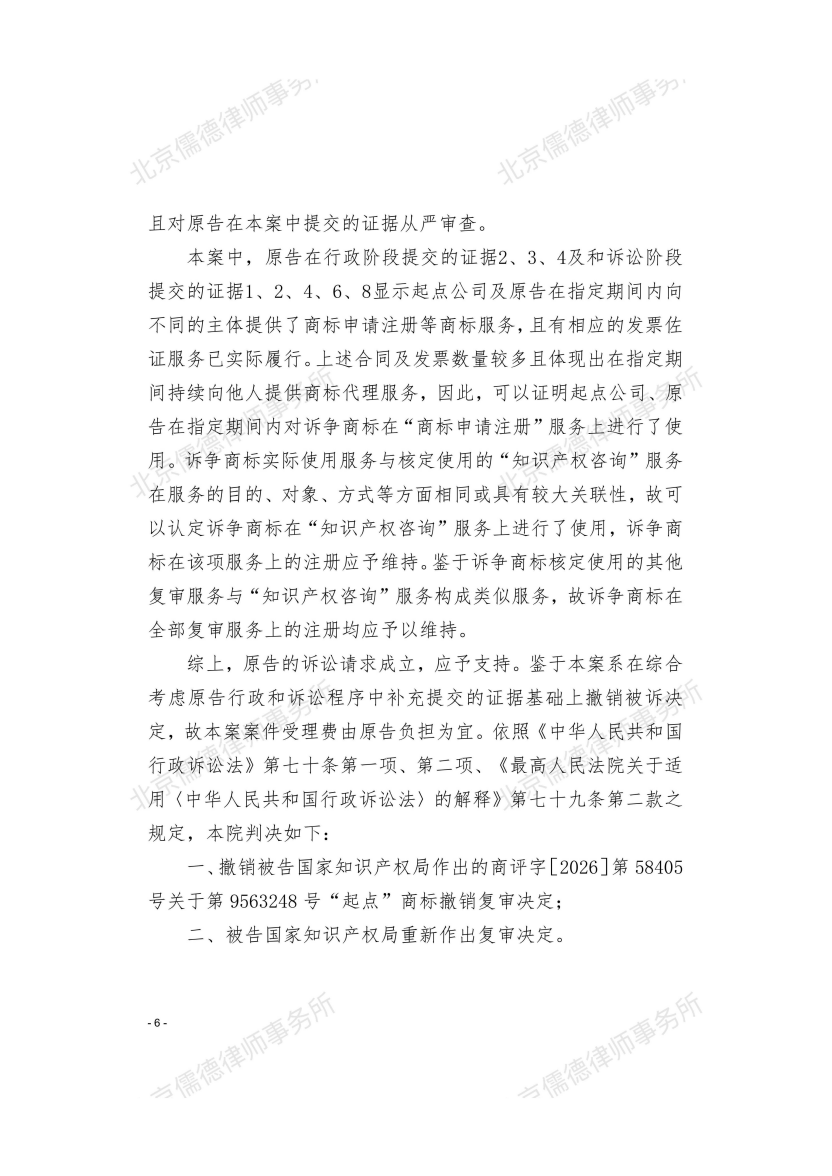
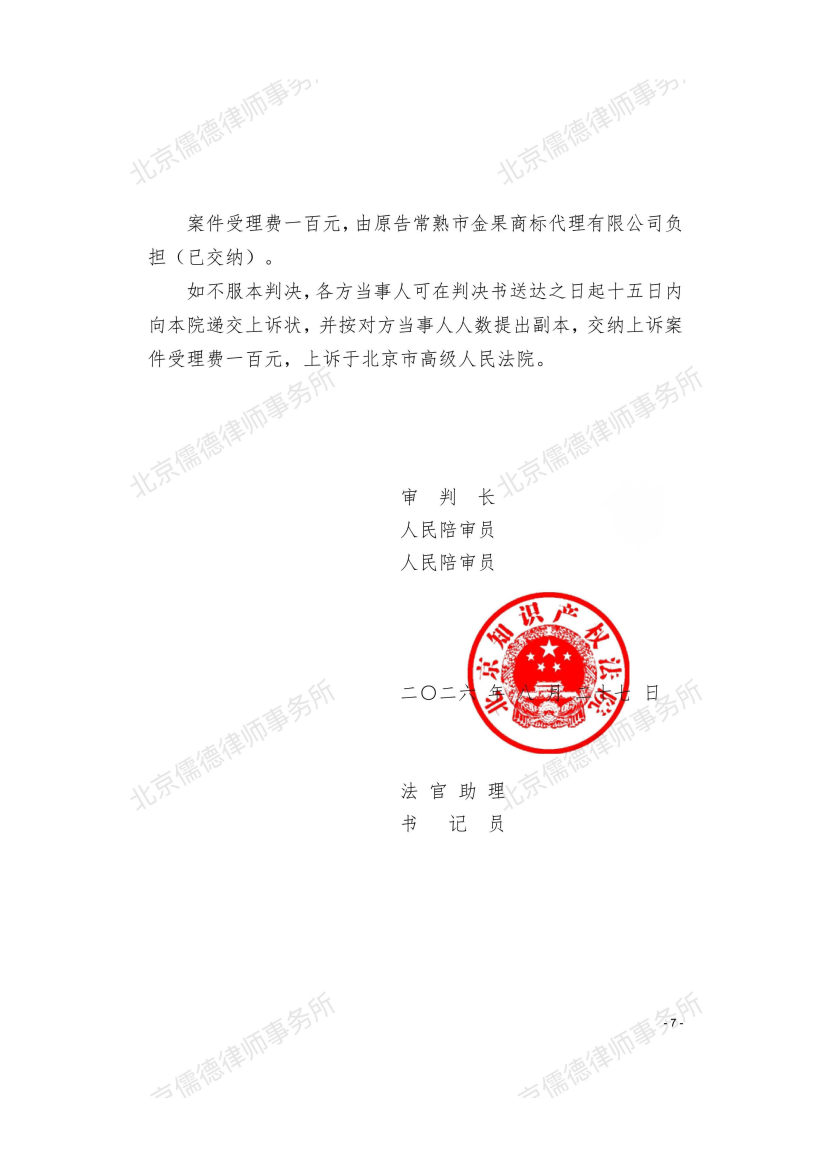
On August 27, 2026, the Beijing Intellectual Property Court fully adopted the representative opinion of Lawyer Rude and ruled to revoke the State Intellectual Property Administration's review decision No. 58405, ordering the defendant to make a new review decision. The registration of the "Starting Point" trademark has been maintained in all approved services, and Company A has won a comprehensive lawsuit, preserving the brand value accumulated over the years.
Lawyer's reminder
This case is a vivid lesson on trademark management. Firstly, evidence is the lifeline of the three withdrawal cases. In daily operations, it is essential to retain original materials such as contracts, invoices, payment vouchers, and communication records that can be mutually verified, forming a complete chain of evidence; Secondly, the issuance of invoices must be truthful and standardized, and no remarks or alterations should be made afterwards. In this case, the eight invoices were not accepted due to the addition of the words "Starting Point Trademark" in the remarks column, which led to a strict examination of the entire case evidence and a profound lesson; Thirdly, electronic evidence should be fixed in a timely manner, and WeChat chats, emails, etc. should be saved as early as possible through notarization, blockchain storage, and other methods to prevent loss or difficulty in verification; Fourthly, the use of trademarks should retain true business traces corresponding to the approved services, and the service categories should cover the approved scope as much as possible; Fifth, the failure of administrative procedures is not final, and new evidence can still be added during the litigation stage. Timely entrusting professional lawyers to evaluate the relief path can often turn danger into safety and reverse the situation.